
Nine Signals from SXSW 2026: Lucas Daibert, Binder, and the Questions Agencies Should Be Asking Now
From AI and work to art, storytelling, emotional connection, and human agency, Lucas Daibert’s latest reflection offers a sharper way to read where strategy and creativity are heading next.
5/5/20263 min read
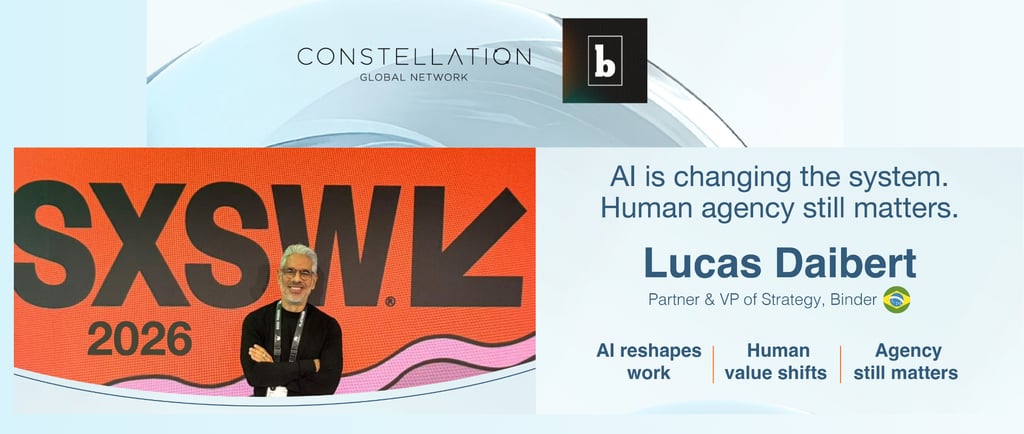
In an article for Janela Publicitária, Lucas Daibert, Partner & VP of Strategy at Binder, shares nine reflections from SXSW 2026 that go far beyond technology trends. The piece explores a broader shift affecting agencies, brands, and culture alike: as AI reshapes systems, human value moves toward judgment, sensitivity, perspective, and agency.
The most relevant ideas coming out of SXSW 2026 were not only about tools.
They were about what those tools are changing underneath.
That is what makes the recent article by Lucas Daibert, Partner & VP of Strategy at Binder, especially worth reading. Published in Janela Publicitária under the title “Meus nove insights do SXSW 2026”, the piece is framed not as a list of trends, but as a deeper reflection on a world being reconfigured in real time — across work, education, creativity, emotional connection, and human agency. Janela identifies Lucas as “sócio e VP de Estratégia da Binder” and presents the article as his reading of this year’s festival.
What gives the text its strength is that it does not stop at the obvious. Instead of treating AI as a simple efficiency upgrade, Lucas describes something more structural. Quoting Ian Beacraft, he writes that we are not living through a software change, but a system change, one that will force people and companies to rethink how work is organized, how value is created, and how human contribution is defined. In that context, he argues that critical thinking, emotional ability, peripheral vision, and social repertoire become more important — because in a world with abundant answers, what still matters is knowing how to ask better questions.
That idea runs through the nine insights in different ways.
The article moves from the future of work to the limits of industrial education, from rapid prototyping and cheaper experimentation to art as a refuge for imperfection, from the possibility of hearing other species through AI to the rise of personalized storytelling and emotional relationships with bots. It is broad, but not scattered. The common thread is clear: as automation expands, human value shifts upward — toward context, interpretation, emotion, judgment, and the ability to hold complexity without reducing it too quickly.
Two sections are especially powerful for agencies.
In one, Lucas reflects on a world where technology allows users not just to choose stories, but to generate their own customized narratives. What begins as marketing personalization becomes something more unsettling: the elimination of chance, friction, and exposure to difference. In another, he addresses the rise of emotional relationships with AI, noting how quickly these bonds are already moving from technological novelty to real affective reality. In both cases, the issue is not simply innovation. It is what happens to people, brands, and culture when experience becomes too frictionless, too optimized, and too detached from shared reality.
The article closes on the most important point of all: “Num mundo de agentes, não podemos abrir mão da nossa agência.” That line captures why the piece matters now. The real challenge is no longer only technological. It is political, cultural, and existential. As systems become more automated, the risk is not only that tasks change, but that people slowly stop exercising the human capacities that make strategy, creativity, and collective life meaningful in the first place.
For Binder, this kind of reflection reinforces a positioning built around more than execution. On its official website, the agency presents itself through the idea of “Reimagine”, signaling a market posture shaped by transformation, reinvention, and strategic thinking.
For Constellation, this is exactly the kind of member voice worth amplifying: thoughtful, strategic, internationally engaged, and willing to ask better questions about where the industry is heading.
Because the agencies that will matter most in the years ahead will not be the ones only reacting faster.
They will be the ones understanding more deeply what still needs to remain human.
If you want your agency to be part of conversations and connections like this across markets, join Constellation.
Explore more:
Article: https://shorturl.at/Fugaq
Binder: binder.com.br
Constellation: constellation.network

